
Sarasii (Exposure Well): Complete Guide | Manyō Ruins and the History of Hitachi Province Fudoki in Mito City, Ibaraki Prefecture
Sarasii (曝井), located in Atagomachi, Mito City, Ibaraki Prefecture, is a precious spring water site where ancient Japanese literature and history come alive. Praised in the Man’yōshū and recorded in the Hitachi Province Fudoki, this place harbors over 1,200 years of history and is carefully preserved as Mito City’s sole Manyō ruin, a regional cultural heritage site.
This article provides a detailed explanation of Sarasii’s historical background, its connection to literary works, its current state, and access methods to this valuable historic site.
What is Sarasii (曝井)?
Sarasii is an ancient spring water site located at 2143-1 Atagomachi, Mito City, Ibaraki Prefecture. The name “sarasii” derives from the practice of “sarasu” (晒す), meaning to bleach cloth at this spring.
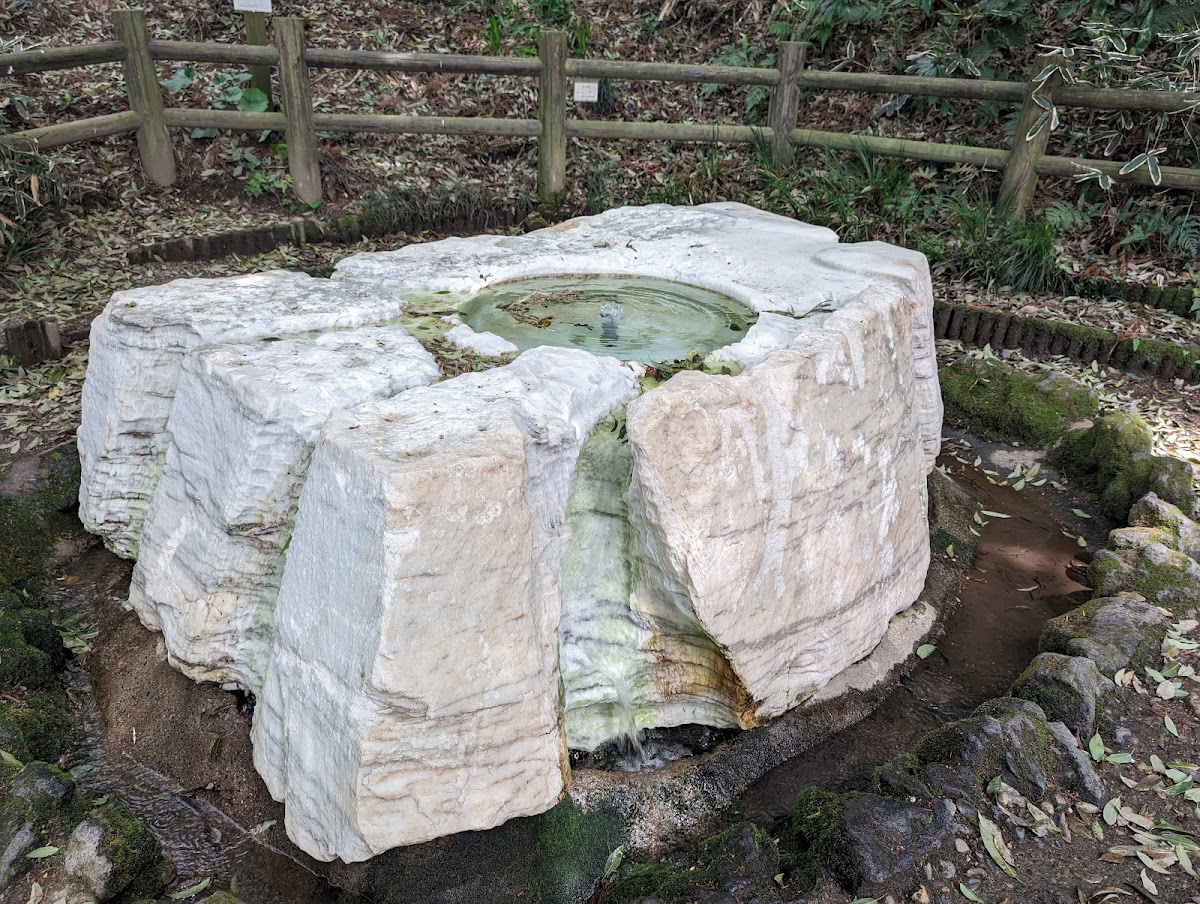
Today it is maintained as a park called “Manyō Sarasii no Mori” (万葉曝井の森), serving as a gathering place for citizens. It is positioned midway down the slope called Takizaka, to the west of the Atagoyama Tumulus and to the right of the area called Sarashidai (曝台).
Geographical Location of Sarasii
Sarasii is situated slightly to the northeast of Mito City’s center, near the Atagoyama Tumulus, a historical structure. It is a spring that wells up midway along a slope called Takizaka, with clear water flowing continuously since ancient times.
This region belonged to Nakakori (那賀郡) and was an important traffic junction within Hitachi Province. A station (umaya) was established across the Awekawa (present-day Nakagawa), and the area flourished as a region through which ancient official roads passed.
The Sarasii in the Hitachi Province Fudoki
The Hitachi Province Fudoki is a geographical record whose compilation was ordered in 713 CE (Wadō 6) in the early Nara period. The Nakakori section contains a description of Sarasii.
Original Text and Modern Translation of the Fudoki
The Hitachi Province Fudoki records the following:
“From the county office, to the northeast, beyond the Awekawa, a station is established. South of that, a spring emerges from amid a slope. With abundant flow and exceptional clarity, it is called Sarasii. Women from the village settlements along the spring, in the summer months, gather together, wash cloth, and dry it by exposing it to the sun.”
In modern language, this translates to:
“From the county office to the northeast, beyond the Awekawa (Nakagawa), a station is established. South of that location, a spring wells up from the middle of a slope. The water flows abundantly and is exceptionally clear, and it is called Sarasii. Women from the village settlements living near this spring gather during the summer months to wash cloth and dry it by exposing it to sunlight.”
This account reveals that the spring was deeply connected to the lives of ancient people. Particularly during summer, it functioned as a communal workspace where women gathered to wash and dry cloth.
Historical Significance of the Hitachi Province Fudoki
The Hitachi Province Fudoki is an exceptionally precious document, preserved in nearly complete form among the extant Fudoki records. Among the Fudoki compiled nationwide, only a few remain in nearly complete form—such as the Hitachi Province Fudoki, Izumo Province Fudoki, and Harima Province Fudoki—making it an extremely important historical source for understanding ancient Ibaraki Prefecture.
The description of Sarasii is not merely geographical information but also a valuable folkloric source transmitting knowledge of the life practices and social conditions of the time.
Sarasii in the Man’yōshū
Sarasii also appears in the Man’yōshū. It is recorded as poem number 1745 in volume nine of the Man’yōshū, attributed to Takahashi no Muraji Mushimaro (高橋連虫麻呂).
The Poem by Takahashi no Muraji Mushimaro
“Mitsukuri no / Naka ni mukaheru / Sarasii no / Taezu kayoham / Soko ni tsuma moga”
(三栗の / 中に向へる / 曝井の / 絶えず通はむ / そこに妻もが)
Interpretation of the Poem
The modern translation of this poem is:
“Like the Sarasii spring flowing toward the center of Mitsukuri, I wish to visit constantly without cease, and oh, that my beloved wife might be there.”
“Mitsukuri” (三栗) is an ancient name for Mito, and is said to be the origin of “Mito.” The poet overlays the image of permanence and unchanging affection onto the clear Sarasii spring that flows ceaselessly.
The poem employs makura-kotoba (pillow words) and kakekotoba (pivot words) skillfully, in the manner characteristic of the Man’yōshū, and by incorporating the specific place name Sarasii, it connects the landscape of Hitachi Province with human emotion.
About Takahashi no Muraji Mushimaro
Takahashi no Muraji Mushimaro was a court poet of the Nara period who left many long and short poems in the Man’yōshū. He is known as a poet who frequently composed poems on regional phenomena and was said to have traveled widely, broadening his knowledge and experience.
It is believed that when he visited Hitachi Province, he saw Sarasii in person and was moved by its clear spring water, composing this poem. Through this poem, Sarasii transcended being merely a local spring to become a place name recorded in Japanese literary history.
Mito’s Sole Manyō Ruin
Sarasii is officially recognized as Mito City’s sole Manyō ruin. It is an extremely precious cultural property in that a place mentioned in the Man’yōshū can still be identified today and the spring continues to flow.
While there are several places in Ibaraki Prefecture mentioned in the Man’yōshū, Sarasii is the only one in Mito City, making it an important element of the region’s historical identity.
The Etymology and Meaning of the Name Sarasii
The name “Sarasii (曝井)” reflects the ancient life culture.
The Act of “Sarasu” (曝す)
“Sarasu” (曝す) refers to the process of exposing washed cloth to sunlight and wind for bleaching and drying. In ancient times, to finish hemp cloth and silk cloth beautifully, it was essential to wash them in clear water and dry them by exposure to the sun.
Because the Sarasii spring had abundant water flow and excellent water quality, it became an optimal location for cloth washing and an important communal workspace where women from surrounding settlements gathered.
The Meaning of “Ii” (井)
“Ii” (井) is an ancient word meaning “spring” or “flowing water.” It shares the same etymological origin as the “i” in “ido” (井戸, well), referring to water welling up from underground or facilities utilizing such water.
Although Sarasii is a naturally occurring spring rather than a manually dug well, the ancient people called spring water sites “i.”
Expression in Local Karuta
The Mito local karuta contains a card that reads “Chitose yuku Sarasii no izumi” (千歳湧く曝井の泉, “A thousand years flowing from Sarasii’s spring”). “Chitose” (千歳) means one thousand years, expressing the history of Sarasii flowing continuously for long ages without cessation.
Through this karuta, the history and cultural value of Sarasii are transmitted to the children of the region.
Present-Day Sarasii – Manyō Sarasii no Mori Park
Today, Sarasii is preserved within a park developed as “Manyō Sarasii no Mori.”
Overview of the Park
Manyō Sarasii no Mori is a park developed to preserve the historically significant spring while providing a space for citizens to relax. In a verdant environment, the Sarasii spring continues to flow quietly.
Within the park:
- The Sarasii spring water site
- Explanatory signboards (introducing records from the Hitachi Province Fudoki and Man’yōshū)
- Poetry stone monument
- Walking paths
- Rest areas
All allow visitors to enjoy historical exploration and nature observation.
Current State of the Spring Water
The Sarasii spring, with over 1,200 years of history, continues to flow without cessation today. However, due to urbanization of the surrounding area and fluctuations in groundwater levels, the water flow is said to be less abundant than it once was.
Nevertheless, the sight of clear water continuing to well up retains vestiges of ancient times and evokes a sense of historical romance in visitors.
Poetry Monument and Memorial Markers
Within the park stands a stone monument inscribed with the Man’yō poem by Takahashi no Muraji Mushimaro. Additionally, an informational board introducing the Hitachi Province Fudoki’s account allows visitors to understand Sarasii’s historical background.
Local cultural organizations and history enthusiasts regularly conduct cleaning and maintenance, preserving it as a regional symbol.
Historic Sites Around Sarasii
Several historically important sites are scattered around Sarasii.
Atagoyama Tumulus
Located to the east of Sarasii, the Atagoyama Tumulus is an earlier-middle mounded tomb estimated to have been constructed between the late 5th and early 6th centuries. With a total length of approximately 136.5 meters, it ranks among the largest tumuli in Ibaraki Prefecture and speaks to the power of ancient regional clan leaders.
The proximity of Kofun-period structures and Nara-period literary ruins indicates that this region was long a significant center.
Takizaka (滝坂)
Takizaka, where Sarasii is located, is a slope that has continued from ancient times and is interesting both geographically and historically. The location of a spring emerging midway down the slope perfectly aligns with the Fudoki’s description.
The Nakagawa (那珂川)
The Nakagawa, recorded as “Awekawa” in the Hitachi Province Fudoki, is the primary river in Ibaraki Prefecture flowing to the east of Sarasii. In ancient times, it served as an important waterway for transportation of goods and people.
Access to Sarasii
Here is access information for visiting Sarasii.
Location
2143-1 Atagomachi, Mito City, Ibaraki Prefecture
(Within Manyō Sarasii no Mori Park)
Access by Public Transportation
- From JR Jōban Line “Mito Station”:
- Approximately 15 minutes by bus from the north exit
- Get off at “Atagomachi” bus stop (Ibaraki Kotsu bus), approximately 5 minutes on foot
Access by Car
- From “Mito IC” on the Jōban Expressway:
- Approximately 20 minutes via National Route 50
- Parking: Limited spaces available around the park
Precautions When Visiting
- The park is open at all times, but avoid visiting at night
- As the spring is a valuable cultural property, please cooperate in its preservation
- It is recommended to tour slowly while checking the explanatory signboards and poetry monument
- The surrounding scenery changes with the seasons, so visiting in all four seasons is enjoyable
Cultural Value and Preservation Activities of Sarasii
Sarasii is not merely a spring but a precious cultural heritage transmitting ancient Japanese literature and history to the present.
Hitachi Province Fudoki 1,300-Year Anniversary Project
2013 (Heisei 25) marked 1,300 years since the compilation of the Hitachi Province Fudoki. Ibaraki Prefecture undertook commemorative projects, and Sarasii attracted attention as a site associated with the Fudoki.
The prefecture’s official website featured Sarasii in a “Visiting the Hitachi Province Fudoki” section, drawing many history enthusiasts and tourists.
Regional Preservation Activities
Mito City and regional cultural organizations are engaged in preserving and utilizing Sarasii:
- Regular cleaning and environmental maintenance
- Installation and updating of explanatory signboards
- Utilization in local education
- Scholarly research as a cultural property
- Promotional activities as a tourism resource
Through these efforts, Sarasii is preserved as a cultural heritage to be passed to future generations.
Educational Value
Sarasii holds significant importance in local school education. It serves as a subject for elementary school local studies and social studies field trips, and as an on-site teaching material for classical literature studies in junior high and high schools.
Visiting an actual place mentioned in the Man’yōshū and Fudoki allows ancient literature to be felt more directly and fosters affection for one’s region.
The Appeal of Visiting Sarasii
Visiting Sarasii offers various attractions.
Experiencing Historical Romance
The fact that a place mentioned in the Hitachi Province Fudoki, compiled over 1,200 years ago, and in the Man’yōshū, still exists today with its spring continuing to flow, evokes a strong sense of historical romance.
By visiting while imagining the landscape the ancient people saw and the scene of women gathering to wash cloth, one can experience a journey transcending time and space.
The Joy of Literary Walks
“Literary walks”—visiting actual locations after reading the Man’yōshū or Fudoki—have become increasingly popular in recent years. Sarasii is a valuable spot for enjoying an authentic literary walk while being relatively easily accessible within Mito City.
Connection with Nature
Manyō Sarasii no Mori, despite being in an urban area, retains abundant natural surroundings. Visitors can enjoy connection with nature through the sound of spring water, green trees, and seasonal flowers.
A Quiet Space for Healing
Remaining relatively unknown as a tourist destination, it rarely becomes crowded, offering a quiet space to savor history and nature. It is an ideal location to escape daily bustle and reflect peacefully.
Sarasii and Ancient Ibaraki History
The existence of Sarasii is also an important clue for understanding Ibaraki Prefecture’s ancient history.
The Importance of Hitachi Province
In ancient times, Hitachi Province was particularly important among the eastern regions. Blessed with fertile land and abundant water resources, it served as an important granary for the imperial court and also functioned as an advanced base for expansion into the Tōhoku region.
Nakakori, where Sarasii is located, was near the center of Hitachi Province and was also a traffic junction. The presence of a station indicates it was an important region through which official roads passed.
The Relationship Between Water and Life
The description of Sarasii demonstrates the deep connection between water and human life in ancient times. Clear spring water was essential not only as drinking water but also for productive activities such as cloth washing.
The practice of women gathering communally to wash and dry cloth is valuable folkloric information revealing the nature of ancient communal society.
The Travels of Manyō Poets
The fact that Takahashi no Muraji Mushimaro, a court poet, visited Hitachi Province and composed a poem about Sarasii demonstrates cultural exchange between the capital and regions during the Nara period. When capital poets traveled through regions and composed poems about local phenomena, these were transmitted to and recorded in the capital.
The Sarasii poem likely served not merely as a personal reflection but as a means of making the existence of Hitachi Province known to the capital.
Conclusion: The Weight of History Transmitted by Sarasii
Sarasii (曝井) in Mito City, Ibaraki Prefecture, is a precious cultural heritage with over 1,200 years of history, appearing in two important ancient documents: the Hitachi Province Fudoki and the Man’yōshū.
This spring, which was a place of life for ancient people and was praised in poems by Man’yō poets, is today preserved as Manyō Sarasii no Mori Park and continues to serve as a gathering place for citizens. As Mito City’s sole Manyō ruin, it remains an important element of the region’s historical identity.
As the local karuta expression “Chitose yuku Sarasii no izumi” suggests, this spring continues to flow across a thousand years, demonstrating to us the continuity of history from ancient to modern times.
When visiting Mito, why not take time to visit this quiet historical spot and reflect on the landscape seen by ancient people? While listening to the sound of clear spring water, you will surely gain a precious experience of realizing the depth of Japan’s ancient literature and history.