Complete Guide to Niko Fuji no Ike (Funabashi City, Chiba Prefecture) | Thorough Explanation from History and Origins to Present State
“Niko Fuji no Ike,” located in Higashi-Nakayama, Funabashi City, Chiba Prefecture, is an important reservoir pond that once supported agriculture and daily life in the water-rich Katsushika region. Known as a valuable historic site transmitting regional culture to the present day, it is recognized for its deep connections with Nichiren the Sage, the legend of an ancient wisteria tree, and a history of agricultural use that continued until the Showa era. This article provides a detailed explanation of Niko Fuji no Ike from its historical background to its present form.
Overview and Basic Information about Niko Fuji no Ike
Niko Fuji no Ike is a historic spring water pond located at 1-chome, 316, Higashi-Nakayama, Funabashi City, Chiba Prefecture. The current pond was restored and developed in March 1998 (Heisei 10), and it retains vestiges of a reservoir pond that once served as an important agricultural water source for the region.
Location and Geographic Characteristics
The Higashi-Nakayama district where Niko Fuji no Ike is located sits at the base of a cliff along National Route 14, stretching from Nakayama to Katsushika. This area is known geologically as a land extremely rich in spring water, with multiple spring water points called the “Katsushika Spring Water Group” existing in the area. Located at the boundary between upland and lowland, this topography was equipped with ideal conditions for groundwater to naturally spring forth, and was intimately connected with people’s lives since ancient times.
Access Information
Niko Fuji no Ike is accessible on foot from either Shimosa-Nakayama Station or Keisei-Nakayama Station on the JR Sobu Line. Due to its location along National Route 14 (Chiba Kaido), it was once an important rest stop for people traveling the highway. Today it still stands quietly in a residential area, serving as a valuable space conveying the region’s history.
Names and Auspicious Origins of Niko Fuji no Ike
The name “Niko Fuji no Ike” carries the region’s history and faith deeply within it. The name’s origin stems from a complex interweaving of local naming, religious background, and natural characteristics.
The Ancient Placename of Niko-ura
The “Niko” in the pond’s name derives from the fact that this region was once called “Niko-ura.” Niko-ura was a placename referring to this area from the medieval through early modern periods, indicating that it was a low-lying wetland close to the sea. In old maps and documents from the Edo period, the placename “Niko” appears frequently, showing that this region was important as a living sphere for people since ancient times.
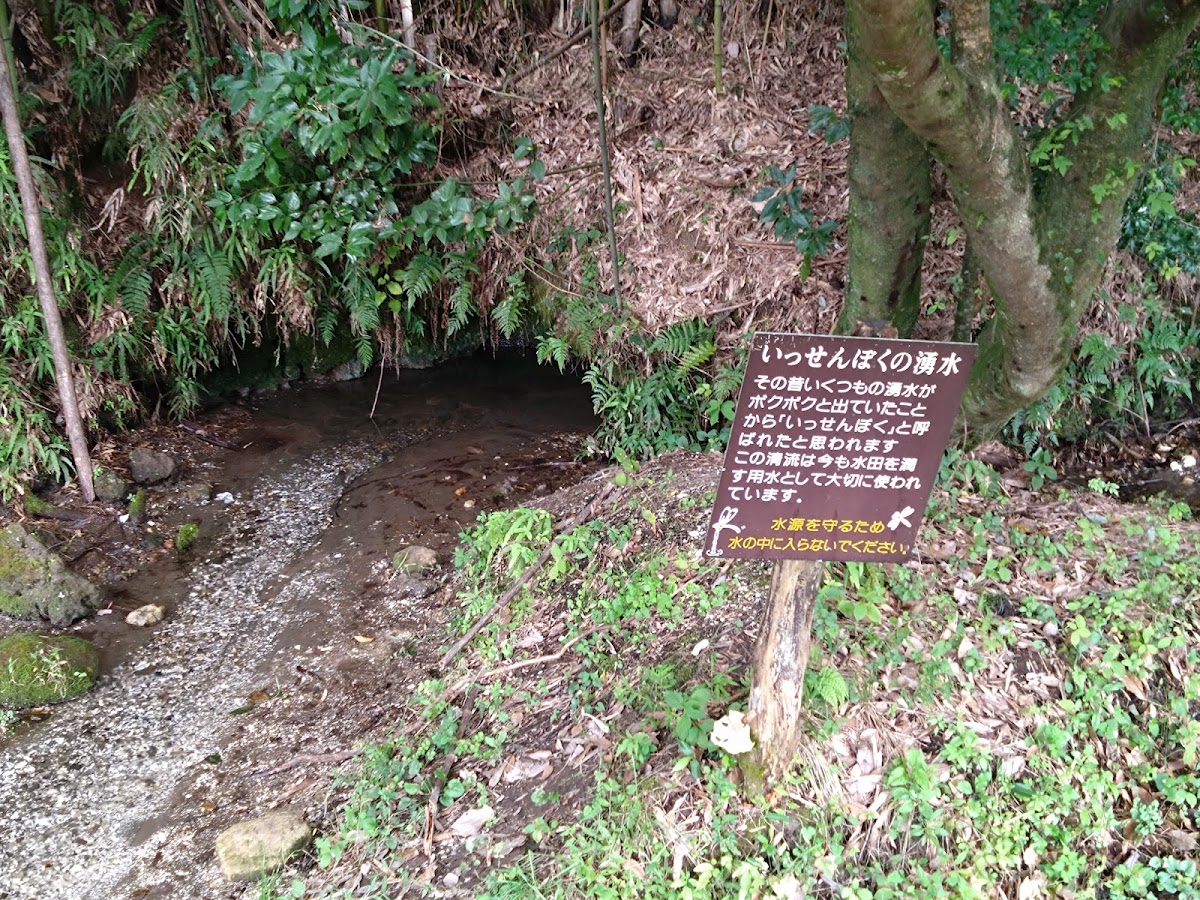
In addition to Niko Fuji no Ike, many other reservoir ponds existed in the Niko area. All of these ponds boasted excellent spring water and were utilized as irrigation water for paddies and for daily life. Some were even prized as water for the tea ceremony, testament to the fine water quality of this region.
Nichiren the Sage and His Journey to Kamakura
The name of Niko Fuji no Ike bears a deep connection to Nichiren, the founder of the Nichiren sect of Buddhism. According to tradition, Nichiren the Sage is said to have departed from the area of Niko-ura for Kamakura. Nichiren was a Buddhist priest of the Kamakura period who traveled throughout various regions to spread the teachings of the Lotus Sutra, and this region is thought to have been an important base for his activities.
Higashi-Nakayama district in Funabashi City has many temples of the Nichiren sect, with numerous Nichiren-related historic sites remaining, including Nakayama Hokekekyo Temple. Niko Fuji no Ike is also connected to local faith as a place to remember the footsteps of Nichiren the Sage. This religious background serves as a factor elevating the pond’s name and historical value.
The Legend of the Ancient Wisteria Tree
The name “Fuji” derives from an ancient wisteria tree that stood on the bank of the pond. Long ago, there was a magnificent wisteria tree in the area surrounding this pond, which blossomed with beautiful flowers in spring, delighting the eyes of people traveling the highway. In Japanese culture, the wisteria flower symbolizes elegance and history, appearing in many waka poems and stories.
Due to its location along the highway, travelers rested at the bank of the wisteria-adorned pond, drank the water, and eased their travel fatigue. This combination of the wisteria tree and spring water pond transcended mere agricultural water source to become a beloved local landmark for people.
In this way, three elements—the placename “Niko,” the legend of Nichiren the Sage, and the ancient wisteria tree—combined to create the name “Niko Fuji no Ike.” This name encapsulates the region’s history, faith, and nature.
The Role as a Reservoir Pond and History of Agricultural Use
Niko Fuji no Ike is not merely a scenic spot but has a long history as a practical facility supporting regional agriculture, particularly in paddy field cultivation.
The Mechanism of the Reservoir Pond Using Spring Water
Niko Fuji no Ike is not a naturally formed spring water pond but a reservoir artificially constructed to collect abundant spring water. The groundwater springing from the cliff base below the upland was collected efficiently and stored to supply water to surrounding paddies, serving as agricultural infrastructure. From the Edo period through the Showa era, such reservoir ponds were indispensable in agricultural villages.
Spring water maintains stable temperature throughout the year and is of good quality, making it ideal for agricultural use. In particular, the spring water in the Niko area had abundant volume and rarely ran dry, with records indicating stable water supply was possible even in drought years.
Use as Tatchia (Seed Well)
Niko Fuji no Ike was also called “Tatchia no Ike.” “Tatchia” refers to “Tane-i” (seed well), a place where rice seed grains are soaked in water to promote germination. This agricultural method is one of the most crucial processes in rice cultivation.
Until the late 1950s (early 1950s), local farmers came to this pond in spring to soak their seed grains. The cold, pure water of the spring provided optimal conditions for seed germination. The stable water temperature allowed seed grains to germinate uniformly, enabling cultivation of healthy seedlings.
This use as “Tatchia” was not merely a water supply but also served as a social gathering place for local farmers. Niko Fuji no Ike played an important role in the exchange of agricultural information and the formation of regional community.
Water Supply System to Paddies
Water channels were established to deliver water from Niko Fuji no Ike to surrounding paddies. Water stored in the reservoir flowed to paddies in the lowlands using gravity. During irrigation periods, farmers cooperated to manage water distribution and ensured equitable water supply.
Such water management systems strengthened regional social cohesion. Water management required cooperative efforts, and the pond’s cleaning and maintenance of water channels were performed through regional resident cooperation. Niko Fuji no Ike contributed not only to agricultural technology but also to the organization of regional society.
Urban Development and Changes to the Pond
Through the post-war period of high-speed economic growth, Higashi-Nakayama district in Funabashi experienced rapid urbanization. This change had significant impacts on the appearance and role of Niko Fuji no Ike.
Changes from Late Showa to Early Heisei
From the 1960s onward, full-scale development as a Tokyo bedroom community began. Paddies were converted to residential land one after another, and the agricultural population declined. Accordingly, the demand for reservoir ponds as agricultural water sources also decreased.
Niko Fuji no Ike, which was actively used until the late 1950s, gradually lost its role from the 1960s onward. As paddies surrounding it changed to residential areas, farmers no longer came to soak seed grains. The pond fell into disrepair and faced the danger of being filled in.
1998 Renovation and Restoration
Driven by awareness of the danger of losing regional historic assets, with cooperation between local residents and Funabashi City, the restoration project of Niko Fuji no Ike was completed in March 1998 (Heisei 10). This project aimed to recreate the former appearance of the reservoir pond as much as possible while transforming it into a waterfront space suited to the modern urban environment.
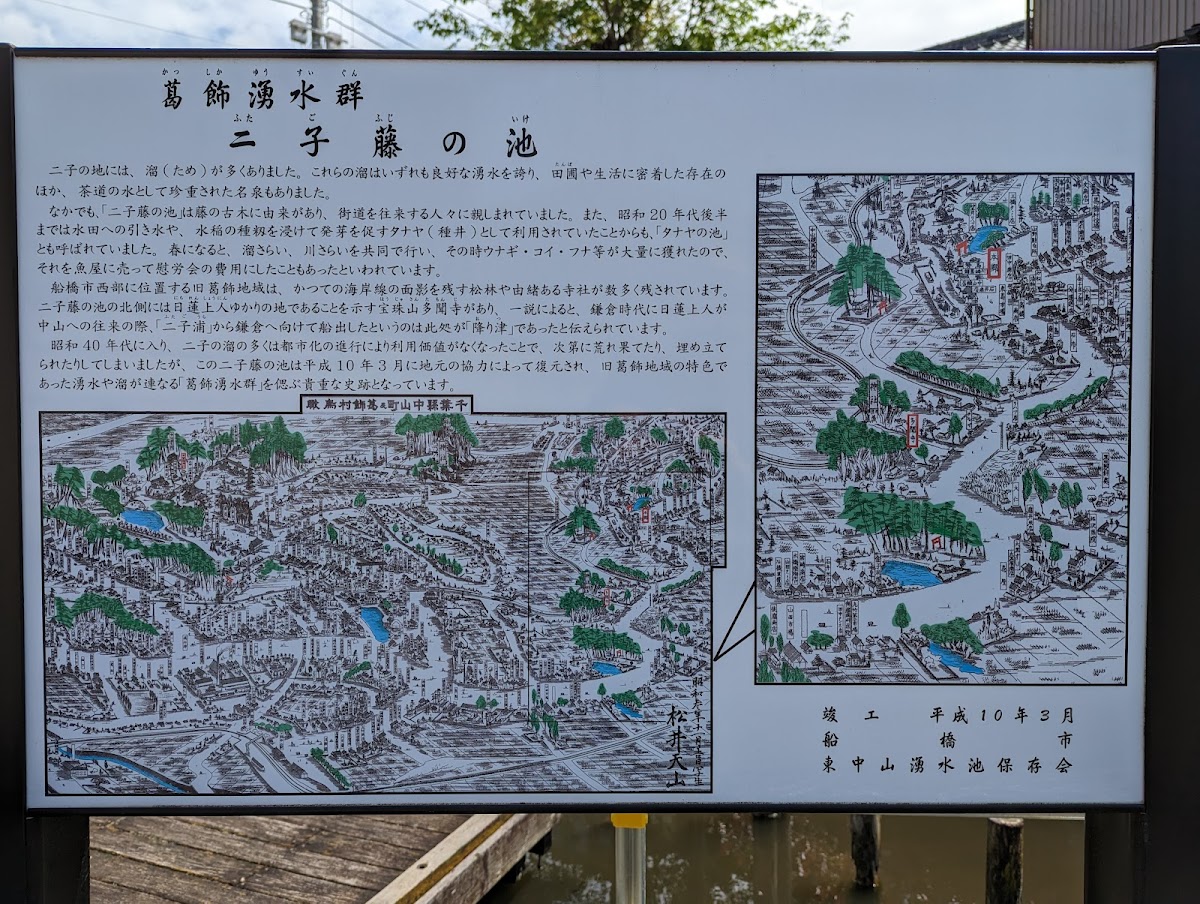
After renovation, the pond has taken on new roles as a gathering place for local residents and a venue for history education, while preserving the characteristics of spring water. Explanatory plaques have been placed around the pond, allowing visitors to learn about its history and origins.
The Katsushika Spring Water Group and Water Environment
Niko Fuji no Ike must be understood as part of the spring water group spreading across the Katsushika region within a broader water environment.
Geological Background of the Katsushika Spring Water Group
The area stretching from Nakayama to Katsushika is located at the margin of the Shimosa Upland. The geological layers composing the upland (primarily the Shimosa Formation Group) are highly permeable, with rainwater easily infiltrating underground. This groundwater springs forth at the boundary between upland and lowland, forming multiple spring water points.
The cliff base along National Route 14 is where this geological structure appears in typical fashion, with multiple spring water ponds such as “Niko-ura no Ike” existing besides Niko Fuji no Ike. These springs have long been utilized as important water resources for the region.
Spring Water Conservation in Modern Times
With urban development, many of the Katsushika spring water points have been lost or seen reduced water volume. Concrete surfacing of the ground has obstructed underground water infiltration, creating problems with declining groundwater levels.
Chiba Prefecture and Funabashi City are working to preserve remaining spring water points. The restoration of Niko Fuji no Ike is part of this effort and has become an emblematic example of efforts to protect the region’s water environment. In the Ministry of Environment’s “Representative Spring Waters” survey, Chiba’s spring waters have been highlighted, with the importance of their preservation being recognized.
Present Appearance and Visiting Information for Niko Fuji no Ike
The current Niko Fuji no Ike is developed as a space combining historical value with modern waterfront space functions.
Current State of the Pond and Surrounding Environment
The renovated pond is located within a residential area, but the surroundings are preserved as greenspace, serving as a precious oasis in the city. The pond’s water uses spring water and has high transparency, and depending on the season, one can observe aquatic plants and small animals.
A walking trail has been developed around the pond and is enjoyed as a walking course by local residents. Benches are also installed, creating a space where one can rest while quietly feeling the history.
Informational Plaques and Learning History
Near the pond, an informational plaque explaining the history and origins of Niko Fuji no Ike has been installed. This plaque provides detailed explanation of the pond’s name origin, its connection to Nichiren the Sage, and the history of agricultural use, allowing visitors to learn about regional history while viewing the pond.
Local elementary schools conduct lessons visiting Niko Fuji no Ike as part of hometown learning, contributing to regional history education. Through actual visits to the pond, children learn about former agricultural practices and the importance of water.
Precautions During Visits
Since Niko Fuji no Ike is located in a residential area, consideration for surrounding residents is necessary during visits. Avoid speaking loudly or discarding trash. Also, entry into the pond may be prohibited, so follow posted instructions.
There is no dedicated parking lot, so use of public transportation is recommended. It is accessible on foot from either Shimosa-Nakayama Station or Keisei-Nakayama Station on the JR Sobu Line.
Modern Significance as an Agricultural Reservoir Pond
Chiba Prefecture has established a database of agricultural reservoir ponds based on “the Law Concerning Management and Conservation of Agricultural Reservoir Ponds.” This is intended to ensure proper management of reservoir ponds and disaster prevention.
The Role of the Reservoir Pond Database
The agricultural reservoir pond database published by Chiba Prefecture contains information on major ponds throughout the prefecture. The database was created for information sharing between prefecture and municipalities and pond owners, and for providing pond information to regional residents.
The database records the location, size, manager, and importance for disaster prevention of reservoir ponds, and is utilized for rapid response during disasters and daily maintenance management.
Disaster Priority Reservoir Ponds and Safety Management
In recent years, with increasing heavy rain disasters, concerns have arisen about damage from reservoir pond failures. Consequently, “disaster priority reservoir ponds” likely to cause human casualties if they collapse have been designated for special management.
Niko Fuji no Ike is currently developed primarily for waterfront purposes and does not function as a large-scale agricultural water source, but within this modern framework of reservoir pond management, efforts are being made to achieve both historical value and safety.
Regional Culture and Niko Fuji no Ike
Niko Fuji no Ike is not merely a physical pond but an embodiment of regional memory and culture.
Memories of Local Residents
For those generations that used the pond until the 1950s, Niko Fuji no Ike is deeply connected with memories of childhood. Memories of assisting parents who came to soak seed grains, memories of playing at the pond’s bank—individual memories are transmitted as the region’s collective memory.
Local regional history research associations conduct activities recording these memories and transmitting them to future generations. Through oral history interviews with the elderly and collection of old photographs, the region’s fading history is being preserved.
Formation of Regional Community
The preservation and development of Niko Fuji no Ike could not have been realized without local resident cooperation. During the 1998 restoration project, local residents actively participated and a movement to protect the pond’s historical value was launched.
Through such activities, regional community solidarity strengthened and attachment to the region deepened. Currently, regional residents participate in pond cleaning activities and surrounding greenspace management, with the pond serving as a hub for community activities.
Surrounding Historic Spots
When visiting Niko Fuji no Ike, exploring surrounding historic spots allows for deeper understanding of the region’s history.
Nakayama Hokekekyo Temple
Nakayama Hokekekyo Temple, the head temple of the Nichiren sect, is located within walking distance of Niko Fuji no Ike. As a temple associated with Nichiren the Sage, it possesses many important cultural properties and holds an important position in Japanese Buddhist history. It is an essential spot for tracing Nichiren the Sage’s footsteps, which relates to the origin of Niko Fuji no Ike’s name.
Other Historic Sites in the Katsushika Region
Throughout the area from Nakayama to Katsushika, numerous historic sites are scattered, including ancient tombs, temples and shrines, and traces of old highways. Exploring these allows one to realize that this region has been a living space for people from ancient times to the present.
Summary: The Regional Memory Conveyed by Niko Fuji no Ike
Niko Fuji no Ike, located in Higashi-Nakayama, Funabashi City, Chiba Prefecture, is a valuable historic site embodying regional history, with three aspects: the legend of Nichiren the Sage, the beauty of the ancient wisteria tree, and the practicality of serving as a reservoir pond for agriculture.
In the Katsushika region once rich in spring water, this pond served as an irrigation water source for paddies and as a seed well for soaking seed grains, supporting regional agriculture. This pond, actively used until the late 1950s, nearly lost its form with the wave of urbanization, but through the enthusiasm of local residents and cooperation with Funabashi City, it was restored in 1998 (Heisei 10).
The current Niko Fuji no Ike serves new roles as a venue for history education, a gathering place for local residents, and a precious water environment within the city. Standing at the pond’s edge and gazing upon its clear spring water, we can recall the lives lived here from the Edo period through the Showa era and envision the agricultural practices that existed alongside water.
Niko Fuji no Ike is a bridge connecting past and present, and an important cultural heritage transmitting regional memory to the future. When visiting Higashi-Nakayama in Funabashi, be sure to stop by this small pond and contemplate the region’s history reflected in its quiet water surface.
Contact Information
For detailed information about Niko Fuji no Ike and inquiries about surrounding historic sites, please contact the following.
Funabashi City Hall
- Address: 2-10-25 Minato-cho, Funabashi City, Chiba Prefecture
- Phone: 047-436-2111 (main line)
- Website: https://www.city.funabashi.lg.jp/
Related Departments
- Culture Division (History and Cultural Properties)
- Parks and Greenspace Division (Parks and Greenspace)
- Agriculture and Fisheries Division (Agricultural Water and Reservoir Ponds)
Those wishing to learn about regional history and spring water environments, school-related personnel seeking to use it for hometown education, and others are welcome to contact us. With local cooperation, more detailed information and viewing of old photographs may also be possible.