
Gyokuryu Fountain (Ibaraki Prefecture) Complete Guide|The History and Highlights of Japan’s Oldest Fountain
The Gyokuryu Fountain, located on Sakurayama in Mito City, Ibaraki Prefecture, is a historic site that has garnered attention from history enthusiasts and tourists as Japan’s oldest artesian fountain, constructed in the late Edo period. This fountain, which resulted from the outstanding hydraulic engineering knowledge and compassion for his people of Tokugawa Nariaki, the 9th lord of the Mito Domain, remains a valuable cultural heritage that speaks to the high level of technology of that era.
This article provides a detailed explanation of the Gyokuryu Fountain, from its historical background and technical mechanisms to its current status and highlights for visitors.
Gyokuryu Fountain Explained|Overview of Japan’s Oldest Fountain
The Gyokuryu Fountain (ぎょくりゅうせん) is a historic fountain facility located on Sakurayama in Mito City, Ibaraki Prefecture. It was constructed during the Tenpō era (1830s) of the late Edo period by Tokugawa Nariaki, the 9th lord of the Mito Domain.
Basic Information
- Location: Sakurayama, near Ibaraki Gokoku Shrine, Mitsukawa 1-2, Mito City, Ibaraki Prefecture
- Period of Construction: Tenpō era (1830s)
- Constructor: Tokugawa Nariaki, 9th Lord of the Mito Domain
- Features: Considered Japan’s oldest artesian fountain
- Related Facilities: Designed as a counterpart to the Togoku Fountain in Kairaku Garden
The Gyokuryu Fountain is not merely a fountain, but rather a facility that embodied the philosophy of “enjoying together with the people” that Nariaki promoted. As part of a grand plan to develop Sakurayama, famous for its cherry blossoms, and Kairaku Garden as complementary attractions, the Gyokuryu Fountain was positioned as a counterpart to the Togoku Fountain (Togokusenn) within Kairaku Garden.
Tokugawa Nariaki and the History of Gyokuryu Fountain
Tokugawa Nariaki’s Garden Design Philosophy
Tokugawa Nariaki (1800-1860), the 9th lord of the Mito Domain, is known as a capable ruler who focused on domain reform. He was particularly interested in the education and welfare of his people, as reflected in the construction of Kairaku Garden.
Nariaki did not simply create a garden for the exclusive use of the domain lord, but rather designed it as a place where people could “enjoy together,” as the name “Kairaku Garden” suggests. This philosophy was also reflected in the development of Sakurayama, and the Gyokuryu Fountain was constructed as a recreational space for commoners, providing them with a place to cool off during the hot summer months.
Background of the Gyokuryu Fountain’s Construction
Nariaki possessed extensive knowledge of hydraulic engineering and was skilled in designing water facilities that utilized differences in terrain elevation. He applied the technology and experience cultivated in the Togoku Fountain within Kairaku Garden to design the Gyokuryu Fountain, cleverly utilizing the topography of Sakurayama.
According to historical records, Nariaki envisioned developing Sakurayama and Kairaku Garden as a pair of scenic spots, positioning the Gyokuryu Fountain as a facility corresponding to the Togoku Fountain in Kairaku Garden. These two fountains, while possessing different characteristics, together represent the pinnacle of Nariaki’s hydraulic engineering technology.
Fountain Technology in the Edo Period
The realization of a fountain in the Edo period, when electricity and pumps did not exist, was a groundbreaking technological achievement. The Gyokuryu Fountain is an artesian fountain that relied solely on natural water pressure, and this technology is highly regarded today as Japan’s oldest fountain.
The Mechanism of Gyokuryu Fountain|Technology of Artesian Fountains
Water Source and Water Channel System
The fountain system of Gyokuryu Fountain was designed to skillfully utilize the natural elevation differences in the terrain. Nariaki constructed a water channel that carried water from Oka no Minamoto (water source) through iron pipes underground to the center of a circular pool.
The water source was positioned at a higher elevation than the fountain, and the water pressure generated by this difference in height was used to propel water upward. Unlike modern fountain systems using pumps, this was a sustainable system that operated solely through the forces of gravity and water pressure.
Fountain Structure
A circular pool was installed at the center of the Gyokuryu Fountain, with the water outlet positioned in its center. The water delivered through the underground iron pipes shot upward vigorously from this central outlet.
According to records, the fountain’s height sometimes reached approximately three meters. During the hottest months, the fountain provided the surrounding area with a cool sound and water spray, offering relief to visiting people.
Comparison with Kairaku Garden’s Togoku Fountain
The Togoku Fountain in Kairaku Garden, which serves as a counterpart to the Gyokuryu Fountain, is also a natural spring that utilizes differences in terrain elevation, though its character differs.
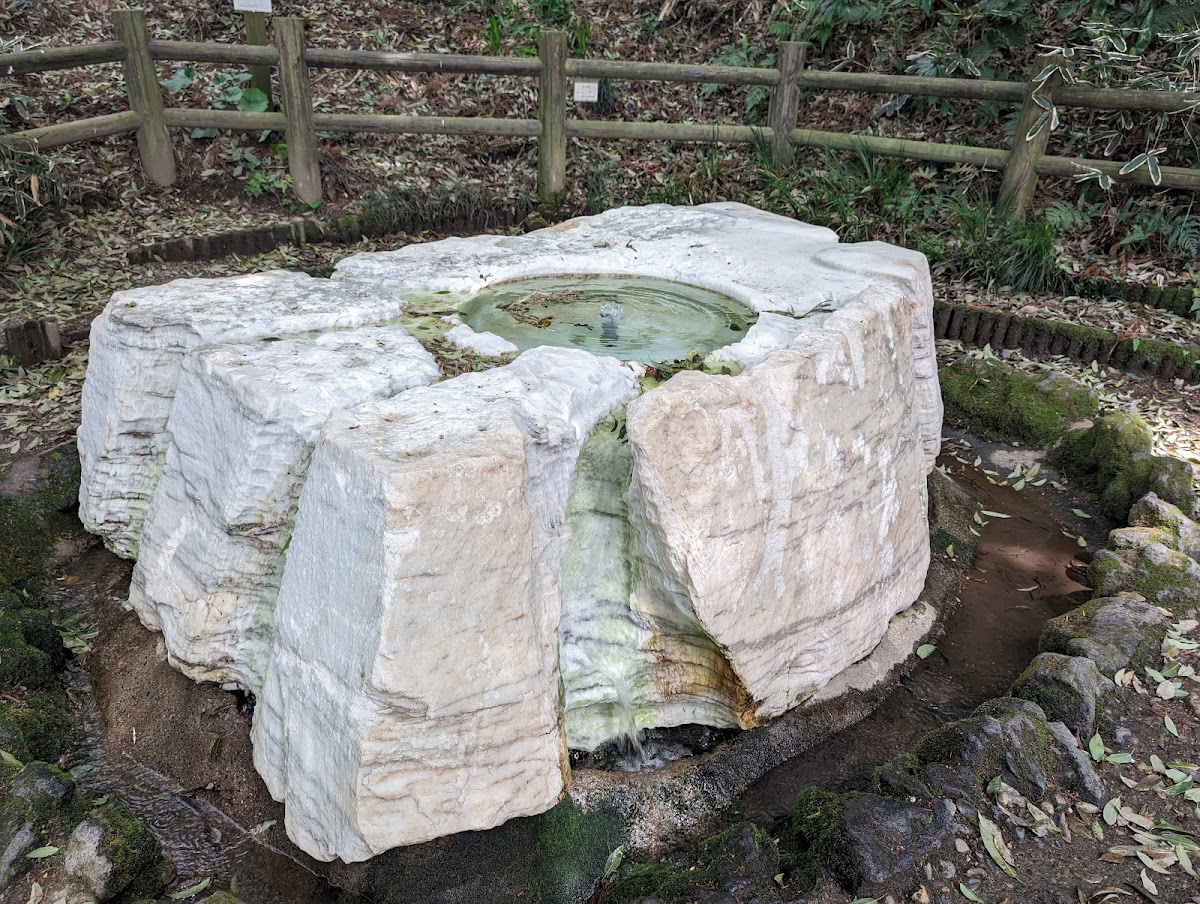
The Togoku Fountain is a natural spring with a white well-curb, and its water was believed to be effective for eye ailments and was used for tea ceremony in the Karō-an tea house of the Kōbuntei. The Gyokuryu Fountain, in contrast, was designed as a more entertainment-oriented facility that provided visual beauty and a sense of coolness through its fountain display.
These two fountains, with their contrasting characters of utility versus entertainment and stillness versus movement, provide an excellent example of the diversity of Nariaki’s hydraulic engineering technology.
The Current Status of Gyokuryu Fountain
Gyokuryu Fountain in Modern Times
Unfortunately, the Gyokuryu Fountain today does not exhibit the active fountain activity seen during the Edo period. Due to the passage of many years and resulting changes to the water source and water channel system, as well as changes in the water system caused by urban development in surrounding areas, the once powerful fountain has ceased operation.
From the Showa period onward, due to water source depletion and deterioration of water channels, the fountain’s function gradually disappeared. Currently, the remains of the circular pool survive and are being preserved as a historic site.
Value as a Historic Site
Regardless of whether the fountain operates, the historical value of the Gyokuryu Fountain remains unchanged. As Japan’s oldest artesian fountain, it is a valuable cultural heritage demonstrating the high level of Edo-period hydraulic technology and holds an important position as a historic site that speaks to Tokugawa Nariaki’s forward-thinking philosophy.
An explanatory plaque is installed at the site, allowing visitors to learn about the history and mechanisms of the Gyokuryu Fountain.
Access to Gyokuryu Fountain and Surrounding Information
How to Get There
By Public Transportation
- Approximately 15 minutes by Ibaraki Kotsu Bus from JR Joban Line “Mito Station”
- Get off at “Sakurayama” bus stop, approximately 5 minutes on foot
By Automobile
- Approximately 20 minutes from “Mito IC” on the Joban Expressway
- Parking available in the surrounding area (Ibaraki Gokoku Shrine parking lot, etc.)
Nearby Points of Interest
Ibaraki Gokoku Shrine
Located just near the Gyokuryu Fountain, Ibaraki Gokoku Shrine is a shrine dedicated to war dead from Ibaraki Prefecture. The grounds are enveloped in a tranquil atmosphere, and many visitors combine a visit to the Gyokuryu Fountain with a shrine visit.
Sakurayama
Sakurayama, where the Gyokuryu Fountain is located, is famous as a cherry blossom viewing spot, as its name suggests. In spring, approximately 370 Somei Yoshino cherry trees bloom magnificently, drawing many flower-viewing visitors. The landscape of Sakurayama, developed by Tokugawa Nariaki, remains a place of relaxation for Mito residents today.
Kairaku Garden
Located approximately 10 minutes by car from the Gyokuryu Fountain, Kairaku Garden is one of Japan’s three most celebrated gardens, alongside Kenroku Garden in Kanazawa and Koraku Garden in Okayama. The Togoku Fountain, which forms a pair with the Gyokuryu Fountain, is also located here, and visiting both is recommended for a comprehensive understanding of Tokugawa Nariaki’s garden design philosophy.
Kairaku Garden is particularly famous as a plum blossom viewing site, with approximately 3,000 plum trees of about 100 varieties planted there. The “Mito Plum Festival” is held annually from mid-February to late March, attracting many tourists from across the country.
Tokiwa Shrine
Adjoining Kairaku Garden, Tokiwa Shrine is dedicated to Tokugawa Mitsukuni (Mito Kōmon) and Tokugawa Nariaki. It is a must-see spot for those interested in the history of the Mito Tokugawa family.
Tips for Visiting Gyokuryu Fountain
Best Times to Visit
Gyokuryu Fountain can be visited year-round, but the recommended seasons are as follows.
Spring (late March to early April)
This is when the cherry blossoms on Sakurayama are in full bloom, and the area around the Gyokuryu Fountain is adorned with cherry blossoms. Combined with the plum blossoms of Kairaku Garden, you can enjoy spring flowers.
Early Summer (May to June)
The fresh greenery is beautiful, and the climate is mild, making it an ideal season for walks. There is a certain charm to visiting while imagining how the Gyokuryu Fountain once provided coolness during the summer heat.
Autumn (October to November)
During the autumn foliage season, the Sakurayama area turns color, and combined with the historic atmosphere, you can enjoy a picturesque landscape.
Photography Tips
When visiting the Gyokuryu Fountain, be sure to bring a camera. The landscape where the remains of the circular pool are in harmony with surrounding nature is also attractive as a photography spot.
- A composition centered on the circular pool with surrounding greenery as the background
- Spring photography combining cherry blossoms with the Gyokuryu Fountain
- Photographs with the explanatory plaque that convey the historic atmosphere
Time Required
Viewing the Gyokuryu Fountain itself takes approximately 15 to 30 minutes. However, if you include visits to the nearby Ibaraki Gokoku Shrine and walks around Sakurayama, you should plan for 1 to 2 hours.
If including nearby tourist spots such as Kairaku Garden and Tokiwa Shrine, it is recommended to plan a half-day to full-day sightseeing course.
Water and History in Mito City|Background Knowledge for Understanding Gyokuryu Fountain
Hydraulic Technology of the Mito Domain
The Mito Domain devoted considerable effort to the development of water management technology throughout the Edo period. Water channel construction for agricultural purposes was advanced from the time of Tokugawa Mitsukuni, and this technology became further refined during Tokugawa Nariaki’s era.
The Gyokuryu Fountain and Togoku Fountain were only made possible through the accumulated hydraulic technology of the Mito Domain. Rather than mere ornamental facilities, they are believed to have served as practical applications of hydraulic engineering, providing learning opportunities for engineers of the time.
Tokugawa Nariaki’s Reform Philosophy
Tokugawa Nariaki is known as a domain reformer who implemented various policies under the philosophy of “enjoying together with the people.” The opening of Kairaku Garden and the development of Sakurayama are representative projects that embodied this philosophy.
The Gyokuryu Fountain can be said to symbolize Nariaki’s reform philosophy, serving both the practical purpose of providing coolness to commoners and the recreational purpose of enjoying a beautiful fountain.
Positioning in the History of Japanese Fountains
The history of fountains in Japan provides almost no examples prior to the Gyokuryu Fountain. While fountain technology had developed in the West since ancient Roman times, fountains were not common in Japan until the Edo period.
In this sense, the Gyokuryu Fountain holds an important position in the history of Japanese fountain technology as its pioneer. The fact that a fountain was realized using independent technology before Western fountain technology was introduced in the Meiji period is particularly noteworthy.
Preservation of Gyokuryu Fountain and Future Prospects
Preservation as a Cultural Property
The Gyokuryu Fountain is currently being preserved as a valuable historical heritage of Mito City. Although the fountain’s function has ceased operation, efforts continue through the preservation of the remains and the installation of explanatory plaques to transmit its historical value to future generations.
Restoration Possibilities
In recent years, restoration projects of historic facilities have been advancing in various locations. Regarding the Gyokuryu Fountain, there have been occasional discussions about the possibility of restoring its fountain function in the future.
However, restoration faces many challenges, including securing a water source, reconstructing water channels, and conducting environmental impact assessments of surrounding areas. There is also a need for deliberation on methodology—whether to faithfully recreate Edo-period technology or to utilize modern technology.
Utilization as a Tourism Resource
Mito City is focusing on tourism promotion centered on Kairaku Garden, but the Gyokuryu Fountain can be described as a hidden gem that is not yet widely known. Efforts to publicize its historical value as Japan’s oldest fountain to more people are anticipated.
Various approaches to its utilization as a tourism resource can be considered, such as establishing sightseeing routes that combine the Sakurayama cherry blossoms, or positioning it as part of a historical walking course tracing the footsteps of Tokugawa Nariaki.
Conclusion|The Charm and Significance of Visiting Gyokuryu Fountain
The Gyokuryu Fountain, standing quietly on Sakurayama in Mito City, Ibaraki Prefecture, is a precious historic site that conveys to the present day the high level of Edo-period technology and the forward-thinking philosophy of Tokugawa Nariaki as Japan’s oldest artesian fountain.
Though the fountain has lost its function today, its historical value remains undiminished. Standing before the remains of the circular pool and imagining the scene where water once shot up to a height of three meters, providing relief to people suffering from summer heat, offers a precious opportunity to reflect on the lives and technology of Edo-period people.
Constructed as a counterpart to the Togoku Fountain in Kairaku Garden, the Gyokuryu Fountain embodies Nariaki’s philosophy of “enjoying together with the people.” The significance of visiting the Gyokuryu Fountain is substantial, not merely as a tourist spot but as a place to learn about Japan’s technological and intellectual history.
When visiting Mito, be sure to visit the Gyokuryu Fountain on Sakurayama in addition to the famous Kairaku Garden. There, the wisdom and ingenuity of Edo-period people and the heart of a domain lord concerned for his people continue to breathe quietly.
Whether in the cherry blossom season of spring, the fresh greenery of early summer, or the autumn foliage, the landscape surrounding the Gyokuryu Fountain presents different faces with each season. An experience touching the history of Japan’s oldest fountain, accompanied by these changing seasonal sceneries, will surely become a memorable experience.