
Kakihanahi-jaa (垣花樋川) Complete Guide|Okinawa Power Spot Among Japan’s Top 100 Famous Waters
Kakihanahi-jaa (垣花樋川), located in the Tamagusku district of Nanjo City, Okinawa Prefecture, is a representative spring water spot in Okinawa that was selected as one of Japan’s Top 100 Famous Waters by the Ministry of the Environment (formerly the Environmental Agency) in 1985. The clear water that gushes forth from layers of limestone has long been used as domestic water by local residents, and is still cherished by many people today as agricultural water and a place of relaxation.
This article provides comprehensive information you should know before visiting, from the historical background of Kakihanahi-jaa, its unique culture, access methods, and information about nearby tourist attractions.
What is Kakihanahi-jaa? History and Culture of Okinawa’s Famous Water
The Meaning and Origin of “Hi-jaa” (樋川)
In Okinawan dialect, “hi-jaa” (樋川) refers to a spring well where spring water is diverted through a kakehii (掛樋). Although there are numerous hi-jaa throughout southern Okinawa Main Island, Kakihanahi-jaa is particularly known for its abundant water volume and excellent water quality.
The place name Kakihana is derived from the Kakihana Castle that once stood here. Clear water continues to gush forth from the middle of a forest below the stone-paved slope of Kakihana Castle ruins, unchanged from the past.
Significance of Selection as One of Japan’s Top 100 Famous Waters
The Top 100 Famous Waters selected by the Environmental Agency in 1985 designates 100 locations throughout Japan with excellent water environments, and Kakihanahi-jaa is a rare selection as the only one chosen in Okinawa Prefecture. This designation was based on comprehensive evaluation not only of water quality but also of historical and cultural value in the region and landscape beauty.
At the time of initial selection, it was recognized as one of 31 locations, and through subsequent additions, it eventually became one of 100 locations. This can be said to be a result of evaluation of the abundance of Okinawa’s water resources and the long-term conservation activities of local residents.
Inagunkaa and Ikigankaa|Traditional Gender-Separated Usage
The greatest characteristic of Kakihanahi-jaa is the existence of two springs side by side. The left side is called “Inagunkaa” (Women’s Stream), and the right side is called “Ikigankaa” (Men’s Stream), and they were traditionally used separately by men and women.
The Role of Inagunkaa (Women’s Stream)
Inagunkaa was a place where women used water for household chores such as laundry and vegetable washing. From the Ryukyu Kingdom era until the early Showa period, women gathered here and, while performing communal tasks, used it as a place for information exchange and social interaction. The water source was not merely a place to obtain domestic water but also served as an important social gathering place for the community.
The Role of Ikigankaa (Men’s Stream)
Ikigankaa was primarily used by men to wash their bodies after agricultural work or to clean farm tools. It was also utilized as agricultural water, supplying water to paddies and fields in the surrounding area. This gender-separated usage is a valuable heritage that conveys Okinawa’s traditional lifestyle culture to the present day and serves as one of the important highlights when visiting Kakihanahi-jaa.
Natural Environment and Scenic Charm of Kakihanahi-jaa
A Healing Space Surrounded by Lush Greenery
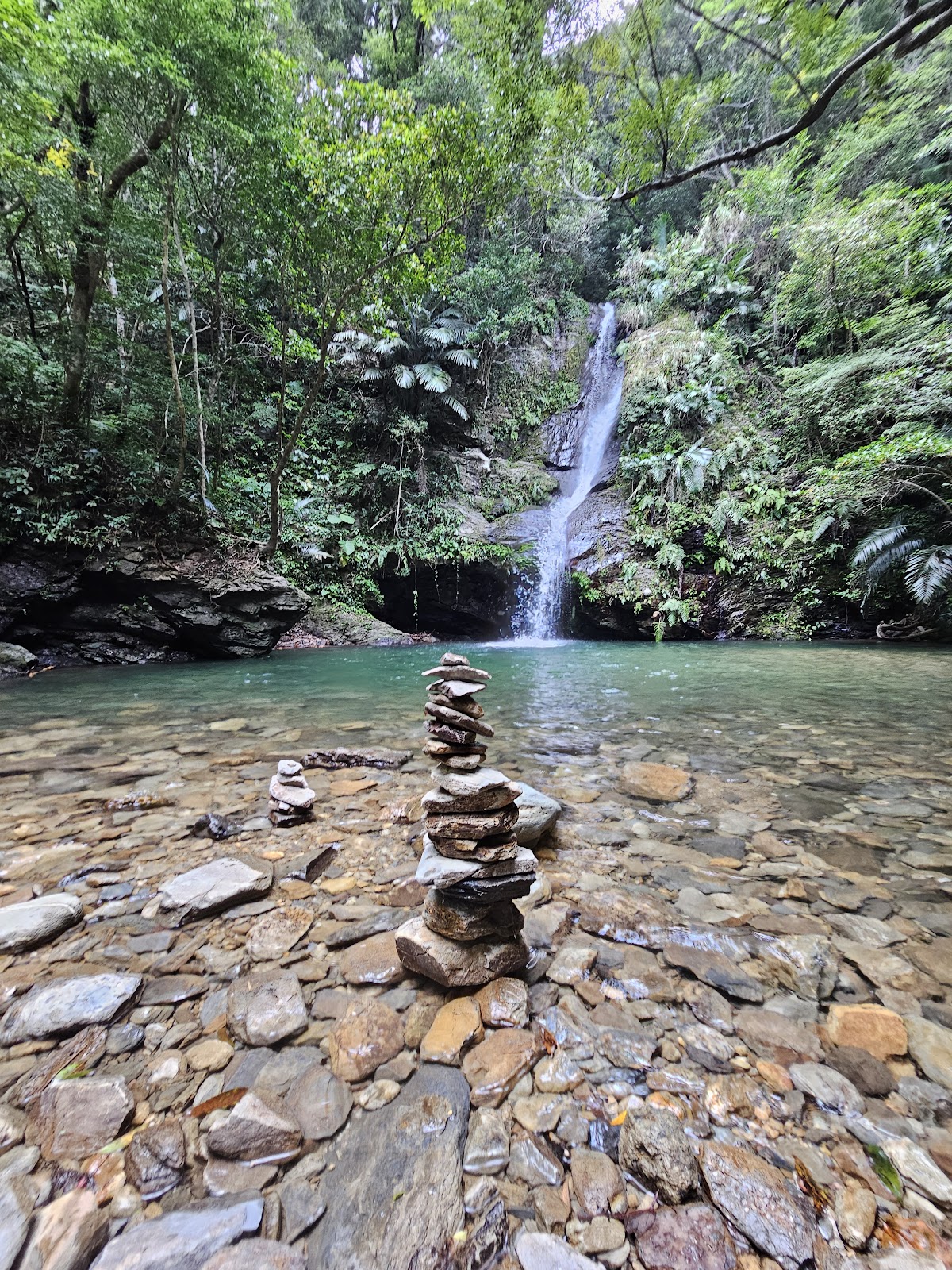
Kakihanahi-jaa is situated on the slopes of a forest surrounded by deep green. Vegetation characteristic of Okinawa’s subtropical climate flourishes abundantly, creating a serene atmosphere that makes one forget the hustle and bustle of the city. In the forest where filtered sunlight shines through, the vigorous sound of clear water gushing forth from rocky roots brings deep relaxation to visitors.
Expansive Cobalt Blue Sea Below
Because the area around Kakihanahi-jaa is positioned on elevated ground, a beautiful cobalt blue sea spreads out below. The contrast between the verdant forest and the blue sea is a scenic view characteristic of Okinawa that captivates many tourists. Especially on clear days, one can take in the grand view of the Pacific Ocean, making it also a popular photography spot.
Rich Ecosystems and Water-Dwelling Creatures
Around the pond filled with famous water, dragonflies and butterflies flutter about, and fireflies can sometimes be seen in summer. Water-dwelling organisms that favor clear water also inhabit the area, making it an ideal location for children’s nature observation. Water plants such as watercress also grow naturally, maintaining a rich ecosystem.
Access Methods to Kakihanahi-jaa
Basic Information
Address: Okinawa Prefecture Nanjo City Tamagusku Kakihana
Phone Number: 098-948-4660 (Nanjo City Tourism and Commerce Division)
Hours: 24 hours open (free to view)
Admission: Free
Parking: Free parking available (approximately 10 spaces)
Access from Naha Airport
By Car
- Approximately 60 minutes from Naha Airport
- From Naha Airport Expressway/Nanpuku Southern IC, head toward Nanjo City via National Routes 507 and 331
- Navigation setting: Search for “Kakihanahi-jaa” or the address
By Public Transportation
Public transportation options are limited, so renting a car is recommended. If using intercity buses, take Route 38 “Shikiya Line” (Toyo Bus) from Naha Bus Terminal, get off at Kakihana Bus Stop, and walk approximately 15 minutes.
Parking and Walking Access
From the parking lot to Kakihanahi-jaa, you descend approximately 100 meters down the stone-paved slope of Kakihana Castle ruins. Some sections of the slope are steep, so comfortable walking shoes are recommended. The stone pavement has a charm that evokes history, and the descent itself can be enjoyed as part of the sightseeing experience.
Current Usage of Kakihanahi-jaa
Role as Domestic and Agricultural Water
Currently, water from Kakihanahi-jaa continues to play an important role as agricultural water for the region. Around the area, cultivation of watercress and okra is flourishing, and agriculture utilizing abundant spring water has become characteristic of the region. Also, some residents continue to use it as domestic water, carrying on the traditional culture of water utilization.
As a Tourist Spot and Place of Recreation
Since being selected as one of Japan’s Top 100 Famous Waters, Kakihanahi-jaa has become recognized as an important tourist spot in southern Okinawa Main Island. Particularly in summer, many tourists and local families visit seeking coolness. The small pond has become an ideal play area for children, and scenes of water play can be observed.
Environmental Conservation Activities
Environmental conservation activities by local residents and Nanjo City are also actively conducted. Through regular cleaning activities and water quality surveys, an environment befitting the Top 100 Famous Waters is maintained. Visitors are also called upon to take litter with them and show consideration for the natural environment.
Information on Nearby Tourist Attractions
Nanjo City, where Kakihanahi-jaa is located, has a concentration of Okinawa’s foremost power spots and tourist attractions.
Seifa Utaki (斎場御嶽)
Located approximately 10 minutes by car from Kakihanahi-jaa, Seifa Utaki is the holiest site in the Ryukyu Kingdom and is registered as a World Heritage site. This is a sacred place mentioned in Ryukyuan creation mythology, where the royal family and the Kikoe-ookimi (high priestess) once made pilgrimages to pray. Visiting both Kakihanahi-jaa and Seifa Utaki allows for a deep experience of both Okinawa’s history and nature.
Chinen Cape Park
A scenic spot that offers a panoramic view of the Pacific Ocean and views of Kudaka Island. Located approximately 15 minutes by car from Kakihanahi-jaa, it is popular as a photography spot for the beautiful contrast of blue sea and sky.
Okinawa World & Gyokusendo Cave
A comprehensive theme park where visitors can experience Okinawa’s culture and nature, featuring the Gyokusendo Cave, said to be the most beautiful stalactite cave in the East. Located approximately 20 minutes by car from Kakihanahi-jaa, it is recommended for families.
Niraikanai Bridge
A scenic drive spot representative of Nanjo City. The view from this beautifully curved bridge descending toward the sea is magnificent. Located approximately 15 minutes by car from Kakihanahi-jaa.
Notes and Manners When Visiting Kakihanahi-jaa
Regarding Drinking
Although it is selected as one of Japan’s Top 100 Famous Waters, it is recommended to check with Nanjo City Hall before drinking. Japan’s Top 100 Famous Waters designation does not necessarily guarantee that the water is suitable for drinking. If you do drink it, it is safe to boil or purify it first.
Cooperation in Environmental Conservation
- Always take litter with you
- Refrain from using detergent or soap to protect water quality
- Be careful not to harm plants or wildlife
- Avoid making loud noise or other behavior that disturbs others
- Avoid parking outside designated parking areas
Clothing and Belongings
- Walking shoes (sneakers, etc.) for traversing the stone-paved slope
- Insect repellent spray in summer
- Parasol or hat (while there is plenty of shade, it is necessary during the walk from the parking lot)
- Towel (if you plan to touch the water)
- Camera (for photographing the beautiful scenery)
Kakihanahi-jaa Through the Seasons and Best Times to Visit
Spring (March to May)
Spring, when fresh greenery is beautiful and the climate is comfortable, is an ideal season to visit Kakihanahi-jaa. Tourist numbers are still relatively low, allowing for leisurely enjoyment of the scenery.
Summer (June to September)
The season with the most visitors seeking coolness. The coldness of the spring water is refreshing, making it popular as a summer retreat in hot Okinawa. However, during the rainy season (late May to June), there is frequent rain and the ground becomes slippery, so caution is necessary.
Fall (October to November)
After typhoon season passes, the climate becomes comfortable again. Tourism calms down, allowing for quiet enjoyment of nature.
Winter (December to February)
Okinawa’s winters are warmer compared to the mainland, but spring water feels cold. Few tourists visit, allowing one to see the hi-jaa as it is rooted in the lives of local people.
History and Culture of Kakihana District
Relationship with Kakihana Castle Ruins
Above Kakihanahi-jaa, there was once a castle called Kakihana Castle (Gusuku). The year of construction is not clear, but it is believed to have been built around the 14th century during the Three Mountains period. The stone-paved path leading to the castle ruins is a precious historic structure that conveys remnants of the Ryukyu Kingdom era to the present day.
Regional Industry Utilizing Water Resources
Kakihana District has long been an area where agriculture flourished by making use of abundant spring water. In particular, paddy field rice cultivation and cultivation of vegetables requiring water were conducted, and the region still maintains water resource-based industries such as watercress cultivation.
Community and Hi-jaa
Kakihanahi-jaa was not merely a water source but a central gathering place for the community. Women gathered to do laundry while exchanging information, and children grew up while playing in the water. Such human activities have continued across generations at this location.
Using Kakihanahi-jaa for Photography and Location Shooting
Kakihanahi-jaa is popular as a filming location for movies, dramas, commercials, and photography due to its beautiful scenery. It is registered as a location with the Okinawa Film Office and has been selected by producers seeking Okinawa-like scenery and historic landscapes.
Precautions for Filming
If conducting commercial or large-scale filming, prior notification to Nanjo City Hall is required. Personal commemorative photography is permitted, but care should be taken to avoid inconveniencing other visitors, such as using tripods or occupying locations for extended periods.
Conclusion: Experiencing Okinawa’s Water Culture at Kakihanahi-jaa
Kakihanahi-jaa, selected as one of Japan’s Top 100 Famous Waters and the only spring water spot selected in Okinawa Prefecture, holds value far beyond being merely a tourist destination. It is a precious place that conveys to the present day the water utilization culture continuing from the Ryukyu Kingdom era, traditional gender-separated usage, and its role as a center of community, reflecting Okinawa’s history and culture.
When visiting Nanjo City, be sure to visit Kakihanahi-jaa along with the World Heritage site Seifa Utaki. The experience of descending a stone-paved slope, surrounded by deep greenery, and encountering spring water will become an unforgettable memory of your Okinawa trip.
The sound of clear water, filtered sunlight, and the blue sea spreading out below—Kakihanahi-jaa is truly a power spot worthy of the name, a place where Okinawa’s natural abundance and the wisdom of people’s lives are in harmony.